

Digital publishing production for businesses targeting audiences in Ghana averages 2.06 months, giving a Ghana digital publication project a planning benchmark rather than a guaranteed deadline. Through services provided by MUZICGH, the schedule depends on the material, editorial review, metadata, and how readers will search and filter the finished content.
A Ghana digital publication is more than a collection of articles online. Clear categories and descriptive metadata help readers find relevant stories, while effective search and filters make a larger archive easier to navigate. Here’s how these features work and what goes into planning, editing and organizing digital content.
Key Takeaways
- Organize content with clear categories and descriptive metadata so readers can find relevant material through search and filters.
- Understand the legal and registration considerations that shape launching a digital publication in Ghana.
- Identify practical risks for digital publishers and learn how editorial and operational choices can affect them.
- See which project decisions influence production time and how MUZICGH’s publication helps readers follow stories shaping Ghana and the wider world.
Content categories, metadata, search, and filtering
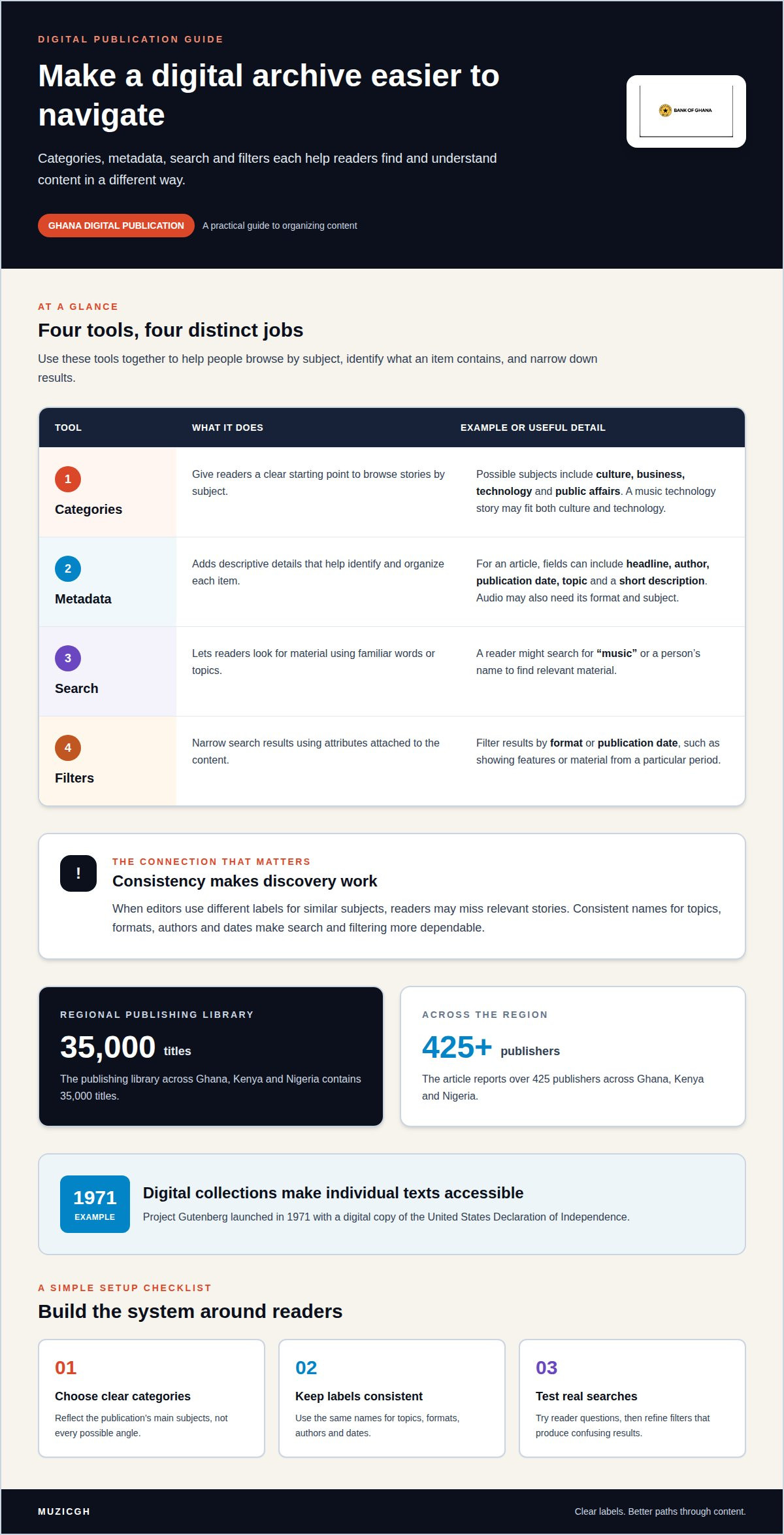
Categories give readers a clear starting point. A Ghana-focused publication might group stories under culture, business, technology and public affairs, so people can browse by subject rather than opening unrelated articles. Categories can also show where subjects overlap: a story about music technology, for example, may fit under both culture and technology. Choose distinct labels and apply them consistently.
Metadata adds details that help identify and organize each item. For an article, useful fields can include its headline, author, publication date, topic, and a short description. For an audio piece, metadata might also identify the format and subject. Project Gutenberg launched in 1971 with a digital copy of the United States Declaration of Independence, illustrating how digital collections can make individual texts accessible as files. Clear titles and descriptions help readers understand what an item contains before opening it.
Search lets readers look for material using familiar terms, such as a person’s name or an article topic. Filters narrow the results by attributes such as format or publication date. A reader might search for “music” and filter the results to features or a particular period. Consistent metadata matters: when editors use different labels for similar subjects, readers may miss relevant stories.
- Choose categories that reflect the publication’s main subjects, not every possible angle.
- Use consistent names for topics, formats, authors, and dates.
- Test searches with real reader questions, then refine filters that produce confusing results.
Digital publishing can bring different media into one collection. Platforms may combine PDFs and white papers with video, audio, and presentation-sharing services. Across Ghana, Kenya, and Nigeria, the publishing library contains 35,000 titles, while the region has over 425 publishers. For a Ghana digital publication, planning categories and metadata early can make a growing archive easier to browse, search, and maintain.
Social media users can share publishers’ content, potentially increasing views, organic traffic, and subscribers. Clear categories and descriptive metadata can also help shared items make sense to new visitors, while consistent labels give them a practical way to explore related material after arriving.
What laws and regulations apply to digital publications in Ghana?
Ghana’s Companies Act is identified as Act 929, a relevant reference when considering a publication’s business structure. It does not, by itself, answer every question about publishing online. A launch plan should separate company administration from decisions about content, reader information, and materials reused from other sources. Treating these as distinct review areas helps you identify which questions need legal attention before publication begins.
Before publishing, map how the operation will work. Record whether it will publish through a registered business, who makes editorial decisions and who handles reader messages. Then consider the content. Quoting someone else’s work raises different questions from producing an original report, while naming an individual calls for careful checks of accuracy, context and potential harm. These are issues to assess, not legal conclusions.
If the publication collects email addresses, account details or messages, document what it gathers and why. Review who can access the information and how long it is retained. This gives the team a clear picture of how personal information is handled. Avoid collecting details that are not needed for the stated purpose.
Images, music, excerpts and embedded media need careful handling. Identify the creator and the terms of use before publishing any material. A contributor-supplied photo, for example, may still require permission for online use. Keep permission records and source details with the material so editors can distinguish original work from content with reuse conditions.
For a Ghana digital publication, a workable pre-launch process is to list the business structure, content risks, data practices, and third-party materials separately. Review those areas with qualified legal guidance when the publication’s format or content raises a specific concern. This approach gives you a concrete checklist without treating Act 929 as a complete guide to every publishing issue.
Registering and launching digital media in Ghana
Start by defining the publication’s purpose, audience and editorial scope. A Ghana-focused outlet might cover business news, music or public affairs. Set out its main subjects and intended readers. This helps guide the name, content plan, publishing schedule and platform design, and clarifies how the publication differs from a personal blog or business website.
Next, decide how the venture will be structured. Ghana’s Companies Act is identified as Act 929, a relevant reference when considering business structure. The Act’s identifier alone does not set out every step for creating a publication. Separate company administration from editorial planning, and record who is responsible for each. That clarity helps a small team understand its roles before publishing begins.
A practical launch sequence can keep the work organized:
- Set the scope. Choose core subjects, such as local affairs and culture, then define the intended readership.
- Plan the editorial workflow. Assign responsibility for commissioning, editing, fact-checking, and publication approval.
- Prepare the publishing platform. Build navigation around the main topics and make article pages easy to read.
- Set content standards. Establish how contributors are credited and how images, quotations, and corrections are handled.
- Test before launch. Review a sample article on desktop and mobile, and test its links and category navigation.
For example, a publication covering Ghanaian business and music could prepare a sample article for each category. Editors can test whether readers understand the labels and whether the workflow catches errors before release. Reviewing these sample pages can also reveal gaps in the homepage, article layout or contact information.
Before publishing regularly, create a simple operating record covering the publication’s purpose, editorial roles, content categories and review steps. Update it when the focus changes. A Ghana digital publication is easier to manage when its public identity matches its internal process: readers can see what it covers, and editors know how each story moves from draft to publication.
Challenges and risks for digital publishers in Ghana
Accuracy is a central editorial risk, especially when a story concerns health, money, or public institutions. A study examined 164 mental health articles from six Ghanaian newspapers published between 2000 and 2015. Misinformation appeared in 1.8% of that sample. The finding concerns those newspaper articles, not every digital publisher, but it shows why health claims need careful review.
The speed of online publishing can create pressure to post before checking the details. A report about a public announcement, for instance, might repeat an outdated date or misidentify someone. Readers can share the error before a correction appears. Use a clear review process: verify names and dates, check claims against source documents, and correct mistakes visibly on the article page.
Content rights and reader privacy also need attention. Keep a record of the source and permission for a contributor’s photograph. If the site collects reader messages, limit access to people who need them. These simple steps help explain routine editorial decisions and reduce avoidable disputes over material or information.
- Keep source notes for factual claims, including names, dates, and figures.
- Record permission details for photographs, excerpts, and contributed work.
- Maintain a correction process that tells readers what changed and why.
Even accurate coverage can be hard to find when headlines are unclear or topic labels are inconsistent. A reader searching for Ghanaian music coverage, for example, may overlook a story filed under a broad or unrelated category. Review headlines, categories and mobile display to spot barriers to discovery. Check published pages too: broken links and inaccessible pages can interrupt reading and sharing, while a regular review helps catch problems early.
For reporting that connects Ghanaian culture and public issues, explore clear coverage of Ghanaian stories.
MUZICGH: MUZICGH digital publication
MUZICGH’s digital publication helps you follow stories shaping Ghana and the wider world through explainers, features, and reporting. Its coverage spans Ghanaian affairs, music and culture, technology and AI, business and money, mental health and psychology, and significant developments across Africa and beyond.
Turn to MUZICGH when you want context on a public issue, cultural story, or change in technology or business. An explainer can clarify the systems behind a headline, while a feature can connect a cultural trend to its wider significance. This coverage provides background to help you understand why a story matters.
Visit muzicgh.com to explore MUZICGH’s coverage.
Keep your publishing plans responsive to readers
Reader questions can help guide what a publication explains next. Notice which subjects prompt follow-up, where readers need more context and whether related coverage is easy to find. For a Ghana digital publication, this feedback can inform editorial choices while keeping coverage focused. Reader responses can also reveal topics that need clearer explanations or fresh reporting.
MUZICGH offers a digital publication for readers seeking context on stories and ideas shaping Ghana and the wider world. Its explainers, features, and reporting help make complex subjects accessible. If you want to explore its work or discuss publishing, take the next step at your own pace.
Contact MUZICGH about publishing and keep building a publication that serves readers with clarity.
Frequently Asked Questions
What does “Ghana digital publication” refer to?
A Ghana digital publication is an online outlet focused on Ghanaian stories, readers or issues. It might be a news site, a culture magazine, or a publication explaining public affairs and technology. For example, it could report on Ghanaian music while covering developments across Africa. Readers access its articles and other media through a website or digital platform.
How can a digital publication help you follow a topic over time?
Look for topic pages that gather related coverage, making it easier to follow a story’s development rather than read isolated updates. A publication might link an explainer about a policy change to later reporting on its effects. Publication dates and clear links between related articles help distinguish background context from newer developments.
How large is Ghana’s digital publishing market and how fast is it growing?
Across Ghana, Kenya, and Nigeria, the publishing library contains 35,000 titles and the region has over 425 publishers. The material provides no growth rate.
How does Ghana’s digital publishing landscape compare with other African countries?
Across Ghana, Kenya, and Nigeria, the publishing library contains 35,000 titles and the region has over 425 publishers. A study of Nigeria’s print book market found that 33 of 109 publishing firms issued digital titles, with 2,014 digital titles across four formats.